Thursday, 14 June 2012

Sunday, 3 June 2012
David Buckingham - RIots and the media - again
He's the author of the MediaMagazine article (see There's a riot going on MM38_Politics_Riots2011 username: mediamagazine9 password: je423st)
and the speaker we just about missed at the London conference in the autumn (see david-buckingham-on-riots-of-2011)
It's a similar presentation but if you need a refresher on the issues raised by the coverage of the riots in the news media, watch this.
Monday, 28 May 2012

Tuesday, 20 March 2012
David Buckingham on the riots of 2011
David Buckingham is Professor of Education at the Institute for Education and Director of the Centre for the Study of Children, Youth and Media.
You may need your mediamagazine user name mediamagazine9 and password je423st
http://www.englishandmedia.co.uk/mm/subscribers/mmclips/clips_conf2_DB1.php
part 1
http://www.englishandmedia.co.uk/mm/subscribers/mmclips/clips_conf2_DB2.php
part 2
About 30 minutes in all.
Covers
- Representations
- Uses and effects
- Public knowledge
- Speaking back to the media
Features discussion of the newspapers we analysed, as well as other media coverage. Also includes the notorious David Starkey appearance on Newsnight on BBC2, and the YouTube mash-ups that followed.
Friday, 3 February 2012
Answering the question
With reference to any one group of people that you have studied, discuss how their identity has been ‘mediated’.
Analyse the ways in which the media represent groups of people.
“The media do not construct collective identity; they merely reflect it”. Discuss.
“Media representations are complex, not simple and straightforward”. How far do you agree with this statement in relation to any one group of people that you have studied?
What is collective identity and how is it mediated?
So as you will notice, the questions may focus on how representations are constructed (or how the media mediate representation/identity) but you also need to consider how people read or make sense of those representations and how groups of people might construct their own identity (e.g. online through social media). The last two questions above essentially cover the same territory, but ask you to reflect upon it in a slightly different way- a quote in a question usually means here is something you can argue with- and you should. I would argue that the media never simply 'reflect' reality but construct a representation of it, so there would be something to really get your teeth into! And a look at contrasting representations of a particular group would allow you to explore the complexity, as indicated in the last question.
If we look at the bullet points in the Specification, which defines what should be studied, we should be able to relate them to the questions set so far:
• How do the contemporary media represent nations, regions and ethnic / social / collective groups of people in different ways?
• How does contemporary representation compare to previous time periods?
• What are the social implications of different media representations of groups of people?
• To what extent is human identity increasingly ‘mediated’?
his part of the exam asks you to do three more specific things, whatever topic you answer on:
1. You MUST refer to at least TWO different media
2. You MUST refer to past, present and future (with the emphasis on the present- contemporary examples from the past five years)
3. refer to critical/theoretical positions
So for 1. you might compare and contrast examples from film and TV or from newspapers and social media.
For 2. the main thing is to ensure you have a majority of material from the past five years. There were a number of answers last year which were dominated by older films, so beware of this!
For 3. you need some critics/writers who have developed ideas about representation and identity. In previous posts on this topic, I referred to several useful theorists in relation to youth as a case study. Have a look at those posts as you should find plenty of use!
You can't cover everything in this exam, as you only have an hour, so you need to be selective and very systematic in your answer. Have case study examples which really illustrate the kinds of points you want to make.
Sunday, 29 January 2012
Friday, 27 January 2012
Practice Question
[50 marks, 1 hour]
Marks are awarded for:
Explanation / analysis / argument = 20 marks
Use of examples = 20 marks
Use of terminology = 10 marks
Refer to 2 media areas - the film Kidulthood and the newspaper articles.
Refer to contemporary representations (the newspaper articles) - this should be the bulk of your answer.
Refer to past representations (Kidulthood will count - ultimately you may want to use something earlier - the old newspaper coverage of the mods and rockers would count).
Refer to what the future of such representations might be (see the quotation from Cohen at the end of the Moral Panics prezi: he predicts there will always be folk devils and moral panics because of the way our society is organised).
Include some textual analysis - details of how the representations are constructed in the texts.
Include some theory - David Gauntlett, Stuart Hall, Stanley Cohen, David Buckingham (the article from MediaMagazine) or others from the blog.
Build your argument. Look for changes over time, or notice the lack of change. Look for similarities and contrasts between the newspapers, or between newspaper representations of the looting and Kidulthood's representations of urban youth. Consider why these differences exist.
Thursday, 26 January 2012
Judith Butler + Kidulthood & Bullet Boy
Examiner Feedback
Media and Collective Identity
Strong responses evidenced a sound grasp on the ideas of David Gauntlett and Judith Butler. Discussion should be spohisticated and supported with detailed examples. Candidates are asked to avoid crude binary oppositions and crass generalisations about whole swathes of young people. Highly contemporary examples should be used and discussed in theoretical contexts such as hegenomy, democracy and representation. Candidates should move away from generalised discussion on how the media represent and engage in more micro discussion about how people give meaning to particular kinds of media in relation to their identity (how do they use music and film and why?)
What is representation
Questions we need to consider are;
whose version of reality is being presented or re-presented?
who is doing the presenting?
who or what is being re-presented?
how is it being re-presented?
to whom is it addressed?
why is it being re-presented in this way?
what view of the world are we given?
how familiar does it look?
Representation is one of the key concepts in media. The media are often described as a 'window on the world' although in fact the media are highly selective in the way in which they construct and represent the world back to us.
Lippmann (1922) argued that what we think and how we act is often based on what we perceive to be true, not on what is actually true. His theory discusses the way people act according to the 'pictures' in their head. These pictures come from the mass media. Crouteau andHoynes (1997) stated that media products go through "processes of selection that invariably mean that certain aspects of reality are highlighted and others neglected" (134). As media students we need to think carefully about not just what is represented on screen but what is not. We need to examine absent representations.
Think about the acts of 9/11. Not many people can claim to have lay witness to the experience and not many people can claim to be actively involved in the ongoing war against terrorism. However,because of images and 'ideas' disseminated by the media 'we all' feel that we have an informed opinion on it.
A good link to Stanley Cohen & Moral Panics

Young People in the Media – www.headsup.org.uk
There's plenty been written on how the media portrays politics. But what about the media representation of young people and their involvement in politics. Stovin Hayter is the editor of Children Now magazine. Here he talks about the damage the press is capable of when it comes public perceptions of young people... You could pick up a local newspaper in almost any part of Britain and see articles that use headlines and terms like:
"... unruly youths... gangs of children as young as 13... terrorising people... youths running wild..."- Edinburgh Evening News
"Like a plague, the city seems to be in the grip of lawlessness among the young."- Peterborough Evening Telegraph
From the tone of these reports you would think that the behaviour they hype up is some new threat to society. They paint a picture of mayhem, fear on the street, and a generation out of control. The word 'youth', in the press, seems to have become synonymous with street crime and antisocial behaviour. Most of those headlines are about real incidents where particular young people have behaved appallingly, and in many cases have made the lives of their neighbours a misery. But from the language and tone used, you would think that teenagers were responsible for the majority of crime and that young people were completely out of control. In fact only 1.8 per cent of 10- to 17-year-olds were convicted or cautioned in 2001. For 21- to 25-year-olds it was 2.4 percent, and for 26- to 30-year-olds it was 2.1 percent. The sense of moral panic that is fuelled by the Press, the shrill demands that "something must be done", influences politicians and people who vote. It fuels public fear. Many people are afraid of young people in hoodies. Teenagers hanging around a bus stop are "threatening" simply because they are there. Eventually, such hysteria feeds into public policy, such as the recently enacted antisocial behaviour law (which many of you discussed in an earlier HeadsUp Forum). That’s the one under which you can now be fined for missing school, or that allows councils to declare zones where curfews can be imposed, and where police will have powers to break up groups of young people if their presence is perceived as threatening. These measures will affect all young people, not just the troublemakers.
Demonising youth
When discussing demonisation it is important to point out that 'youths behaving badly' isn't a new phenomenon and moral outrage about it is nothing new. Here's a few of quotes from way back in the day:
Here's one from Plato (428-348 BC)
“The children now love luxury; they have bad manners, contempt for authority; they show disrespect for elders and love chatter in place of exercise. Children are now tyrants, not the servants of their households. They no longer rise when elders enter the room. They contradict their parents, chatter before company, gobble up dainties at the table, cross their legs, and tyrannize their teachers.”
Swap the word 'dainties' for 'Rustlers microwavable burgers' and he could be talking about today's youth.
Here's a report on the hooligan riots from 1898
'They wore peaked caps, neck scarves, bell-bottom trousers and a hairstyle cropped close to the scalp. There were pitched battles between rival gangs, armed with iron bars, knives, powerful catapults and even guns. They patrolled their neighbourhoods shouting obscenities and pushing people down.'
Compare that with the 2010 film Shank's vision of London 2015
It's quite similar just with less parkour.
Here's Alexander Dervine's (an educator and journalist) take on the reasons for the 1898 riots.
‘Lack of parental control, lack of discipline in schools, base literature (such as the sensationalist 'penny dreadful' novels about pirates and highwaymen) and the monotony of life in Manchester's slums were to blame for the urban guerilla warfare.'
And finally a quote from a 1939 report titled Needs of Youth:
‘Relaxation of parental control, decline of religious influence and the movemnt of masses of young people to housing estates where there is little scope for recreation and plenty for trouble… the problem is a serious challenge, the difficulty of which is intensified by the extension of freedom which, for better or worse, has been given to youth in the last generation.’
And here's a few up to date ones - firstly an exert from an article in the Sun focusing on 'Broken Britain' from Oct 2009:
'Outside two track-suited youths with a pit bull terrier straining at the leash are smirking as they roll what looks like a cannabis joint. Others in hoodies swill cider under signs banning public drinking. My attempts to chat with the youngsters are met with twisted snarls and revolting four-letter abuse. The scourge of feral youths was put in sharp focus earlier this month after suicide mum Fiona Pilkington was hounded to death by bad kids'
And from Gordon Brown from 2008:
'Kids are out of control... They're roaming the streets. They're out late at night.'
So this demonisation of youth is nothing particularly new. Also neither are the supposed causes of the bad behaviour - poor education, poverty, violence in the media, lack of opportunities, absence of parental guidance
Things to think about and consider
1. Can you personally relate to the idea of creating identity using the media? Are there any characters or media personalities who you feel represent you? Do you share the same qualities? Which qualities do you reject and which do you aspire to have?
2. There are examples of Collective Identities being heavily influence by the media particularly youth sub-cultures that are often defined by the type of media they consume:
Mods: fashion (often tailor-made suits); pop music, including African American soul, Jamaican ska, and British beat music and R&B; and Italian motor scooters.
Rockers: 50s biker films, Marlon Brando, Elvis, rock’n’roll.
Even counter-cultural groups (groups that reject mainstream values) like Punk can be define by the type of music consumed and also what media they rejected and are oppositional to. So they were still influenced by the media to the point they took a confrontational stance toward it.
Today, even though there might not be clearly defined sub-cultures, they are still ‘scenes’, members of which are still defined by what music/films etc they consume. Can you think of any? Emo? Steampunk? Goth?
3. Identities are often constructed then perpetuated by the media.
a) The ‘Chav’.
Before the mid noughties most regions had their own term for the type of working youth the term refers to – they were Townies, or Meaders/Bedmies (Bristol). But through Media (websites, news, comedy) use of the word ‘Chav’ it became an all-encompassing term.
It then became a stereotype constructed and re-constructed by the media. For example – you had Vicky Pollard (Little Britain) - Lauren (Catherine Tate Show) – Goldie Look Chain etc,
The result of this is that we have Kelly from Misfits who is created as the stereotypical chav – dress, accent, hair, earrings, pet – even her reason for being on community service was ‘chav’ - head butting someone in Argos!
Misfits creates this stereotype intentional to then deconstruct it with Kelly’s character development.
b) Demonisation
Look here for the role that the Media plays in Demonisation. It can be argued that the Media as created the 'hoodie' - the scary youth - by giving them a high profile in the news, then using this representation in films such as F, Attack the Block, Harry Brown and even Misfits. This representation fits the 'narrative arc' so is continued and perpetuated. If a representation is repeated enough then it can be percieved to be a truth or at least an audience expectation.
4. Media creates identities and types of behaviour that are seen to directly influence behaviour or people’s reaction to that type of behaviour. For instance‘Skins Parties’.
5. The Media is designed to create narratives and therefore identities for people:
a) Watch Big Brother and the way they create characters for the housemates with intro vox-pops, selective editing and reaction shots. Here's Charlie Brooker talking about these types of techniques.
b) Susan Boyle – her whole identity was carefully created from the sandwich eating in the BGT queue, to the music used, to the crowd reaction shots to the image she has now. Can you think of any other examples?
c) (This is big area to explore but it can be argued that the existence of the teenage social group is a media construction. The thought is that due to the post-war prosperity and baby boom in the 1950-60s they was a huge amount of young people with money to spend and so products (films, music, books, magazines) were created to target that demographic)
6. Because of democratisation of the media, we can use media, explicitly to create our identities?
How do you use the internet to create a representation of yourself? Are you on Facebook – how does that create identity – what is the template? How about online worlds and games? Do you (or others) use Twitter or Youtube to express yourself?
How do Collective Identities use the internet to define themselves? Are online communities or Facebook groups important?
The creators of Misfits used Twitter, tumblr and Facebook to construct identities for their characters
7. Have a look at this article, it opens up an interesting idea about the role of Facebook when it comes to identity. The usual idea with Facebook and identity is that it allows you to construct an identity, perhaps one that is perhaps different to the one your friends, family or employers see - it's another side to you. However, this article suggest that because so much of people's life is being lived or recorded and uploaded to Facebook that you end up only being to have ONE identity.
A quote from the article:
"Facebook appears to be deliberately and systematically making it harder and harder for people to vary their self-presentations according to audience. I think that this broad tendency (if it continues and spreads) impoverishes public life. Certainly, the self that I present on this blog is very different from the self that I present in private life (I’m a lot more combative, for better or worse, in electronically mediated exchanges, than I am in person). It’s also very different from the self that I present on the political science blog that I contribute to. Both differ drastically from the self I present to my students. I don’t think I’m unique in this. And one of the things I like about the Internets is that I can present myself in different ways. This isn’t the result of a lack of integrity – you need to present different ‘selves’ if you want to engage in different kinds of dialogue."
So the author is suggesting that in general the internet is liberating in terms of identity and self presentation (so you can rowdy and rude on one forum, more kind and considered on another), but this in contrast with Facebook restricts this idea of fluidity in identity. Your identity isn't mediated - it isn't as selective and edited as you think.
Imagine Facebook being one room. In this one room are your parents, your siblings, your best friends, your teachers, your school friends, your girl/boyfriend, you pals from your football/hockey team - and they all want you to be the version of you they are used to. So you have to be rowdy with your football pals, be polite to your Mum and Dad, and be the romantic caring type to your loved one - everyone gets to see every side of you. You're exposed.
Also here's another discussion on how digital technology - specifically the internet - is affecting how we construct our identity.
Have a read here about a blogger who constructed an identity to bring like to political issues in Syria. It's a very interesting story and throws up question about how we use digital-media, specifically the internet, to explicitly construct identities and for what reasons
To what extent is identity mediated
This is one of the tougher of the prompt questions but does give you plenty of scope to discuss how the media shapes our identities and how we use the media to construct identities.
First thing to deal with is this idea of identity being ‘mediated’:
One definition of ‘mediation’ – ‘a negotiation to resolve differences’ is useful as it introduce the idea of us using negotiated readings of media to help us construct media. So not taking the messages at face value but understanding them in context and using our own experience.
Then there’s Thomas de Zengotita use of the word for his book Mediated: The Hidden Effects of the Media on You and Your World in which he asserts that almosteverything (info, values, news, role models) comes to us through some media (TV, print, web, magazines, films) so will undoubtedly colour/influence our view of life and therefore our own self-definition.
So firstly, there's the process the audiences make in terms of understanding media representations and relating them to themselves. Then there's looking at how the media construct representations (making a conscious selection of what to include and how to present it) in order to create identities for individuals or groups of people.
Using these ideas we can look at this question as asking to what extent is our identity constructed by media, to what extent do we use media and to what extent does media reflect identity.
Useful theory 1: Jacques Lacan - Mirror Stage
‘Lacan's concept of the mirror stage was strongly inspired by earlier work by psychologist Henri Wallon, who speculated based on observations of animals and humans responding to their reflections in mirrors. Wallon noted that by the age of about six months, human infants and chimpanzees could both recognize their reflection in a mirror. While chimpanzees rapidly lose interest in the discovery, human infants typically become very interested and devote much time and effort to exploring the connections between their bodies and their images. In a 1931 paper, Wallon argued that mirrors helped children develop a sense of self-identity.’
While it's not vital to remember all of the above the assertion is that we gain an idea of self-identity through reflection. Lacan suggested a "mirror stage" in which a child begins to develop an identity; it is a point in their life when they can essentially look into a mirror and recognise themselves. It can be argued that audiences are able to form and develop their identity and change the way in which they see or recognise themselves.
Useful theory 2: David Gauntlett's Construction of Identity is very useful as it discusses the power relationship between media and ourselves when it comes to constructing identity.
'The power relationship between the media and the audience involves a 'bit of both' or to be more precise, a lot of both. The media sends out a huge number of messages about identity and acceptable forms of self-expression, gender, sexuality, and lifestyle. At the same time the public have their own even more robust set of diverse feelings on the issues. The media's suggestions may be seductive but can never simply overpower contrary feelings in the audience.'
Useful Theory 3: Althusser's Interpellation
Here's one definition. And here's an attempt to explain it: Interpellation is the process where a human subject is constructed by pre-given structures. This has been taken up some media theorists to to explain how media texts impose their ideology (their set of ideas) on the audience. If you think about it, we're bombarded by messages from the media, messages that make certain assumptions about us (taste, place in society etc), and as soon as we engage with the message we are positioned as a 'subject' rather than an individual. The idea is that we are controlled by these messages and go some way to defining our identity.
This is an quite an extreme view and doesn't account for the fact that texts often have multiple meanings and audience approach texts with different uses in mind.
Useful Theory 4: Judith Butler's Performativity
Butler says: 'There is no gender identity behind the expressions of gender; ... identity is performatively constituted by the very "expressions" that are said to be its results.' In other words, gender is a performance; it's what you do at particular times, rather than a universal who you are. The idea behind this is our identity (specifically here gender identity) is not defined by biology but is actually a performance learned as we grow. As media students we can apply to our study of identity as many of these performances and notions of idenity will be learned from the media.
Theme of youth being let down by adults
A closer look however sees the film continually try and lay the blame at the hands of the parents. The opening credit sequence has the young couple driving up the motorway while listening to a radio phone in discussing the problem of 'youth crime'. The callers continually pass the buck about who was to blame - the parents, the schools, the media - and so creates a representation of society unwilling to take responsibility. This is then expressed again when the couple express their concerns about the youths at the local cafe.
Again, just like Brett in Eden Lake, the Noel Winters character explains that he is just following his father's foot steps. We also learn that Marky is particularly vulnerable due to the upbringing in care he received.
Past Versus Present
Sunday, 22 January 2012
Wednesday, 18 January 2012
Comparing representations from the Daily Express and Guardian articles
What similarities and differences are there in the way they represent
- young people?
- the events of the previous night?
5 things to do with representations
- recognise that all texts make representations
- deconstruct representations to understand the process by which they are constructed
- question the values, points of view and ideologies of those who made the representation
- evaluate the realism / accuracy / truth of any representation
- explore the reading that the text would like its audience to make, and the different readings that they might make, depending on their values, points of view and ideologies
Guardian article - riots - 09.08.11
Analyse the language of the Guardian article.
As with the Express article, look for the ways in which it describes young people and the events of the previous day.
- Copy a selection of evidence and
- comment on how the words construct a particular representation.
Another feature of this article to deconstruct is the references made to the case of Mark Duggan, whose shooting by police in Tottenham led to a protest there, which then escalated into the first disturbances. Make a note of
- how this is referred to
- how many times
- where in the article these references come
Monday, 16 January 2012
Daily Express article - riots - 09.08.11

Friday, 6 January 2012
Kidulthood and the London Riots - A link?
Keeping it reel: urban film and the riots
This year's UK riots made gritty dramas such as Kidulthood and Shank look all too real. But could these films be part of the problem, asks Live magazine's Zindzi Rocque-Drayton

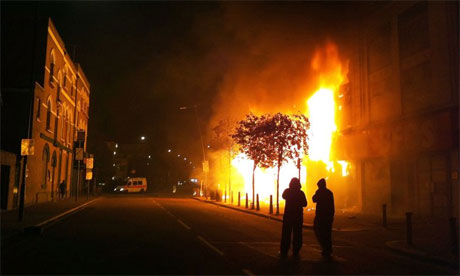
It looked a little like a movie. Cars on fire. Groups of youths in hoodies, their faces covered, running from corner to corner. Shop windows being smashed, and people climbing inside to fetch trainers or TVs or designer cloths. Was it Shank? Kidulthood? Who's starring in this one?
What unfolded on the nation's TV screens between 6 and 10 August wasn't a Sky Movies season of British urban cinema, of course, but the English riots, leaving five people dead and causing an estimated £200m worth of damage to property. And even as they unfolded, there were voices linking the violence to popular culture. On Newsnight, for example, the historian David Starkey huffed and puffed: "What has happened is that the substantial section of the chavs … have become black. The whites have become black. A particular sort of violent, destructive, nihilistic gangster culture has become the fashion." Starkey did not respond to interview requests for this piece, but it's easy to imagine his disgust at seeing one of the recent British films set on an inner-city estate, with black and white characters alike taking and selling drugs, carrying and brandishing guns and knives, talking in identical accents. Maybe he would note the predominance of black characters, and instead of wondering what that said about the British film industry, he would make the assumption that this was everyday black British life.
That is certainly a concern for David Lammy, the Labour MP for Tottenham, whose constituency was where the riots began, and which was especially badly hit. "I think it is a great shame," he says, "something of a travesty that every time we see a portrait of Hackney, Tottenham or Brixton, it is a familiar limited portrait, and it perpetuates a particular imagery and context, when there are many other stories to tell."
Lammy's not the only person to have experienced inner-city life who fears the portrayal of it as a race from one drugs deal to another sends out a particular message. "The effect on our young black people can only be negative when you constantly see your community portrayed, not just in films but on TV programmes, on the news, [with] so much negativity," says Katharine Birbalsingh, who taught in inner city schools for many years. "Young people see that, and yes I do think it helps to glamourise it."
The actor Ashley Walters thinks that is missing the point. "It would be nice for the press and a lot of media people to blame the riots on the urban genre of drama or film," he says. "I guess that's the way to make someone else the scapegoat so that they don't really have to do what they have to do to change it. Things like [the Channel 4 series] Top Boyand Bullet Boy are usually made and produced and put together by people who have a message, and the message they try to get across is that something needs to be done."
That was certainly the intention of Top Boy's writer, Ronan Bennett. "Dramatists over time have tried to grapple with big important issues, and obviously one of the major issues we face right now is the economic and social deprivation that the riots exposed," he says. The questions facing writers, directors and producers now is "how we deal with that in drama, and it can't be by delivering messages, because nobody would watch that show. It has to be cleverer than that: somehow you have got to mix the art of drama with your subject, what you are trying to say about the world. Top Boy really did get people talking. It had an incredible response. I think I probably prefer to think of it as asking questions of the audience and even getting them to ask questions of themselves, how they respond to this culture."
Even when there's an outcry about an urban drama, it at least means it has got people talking about the issues raised. "The majority of people I have spoken to about Top Boy were happy about it," says Walters, one of the show's stars. "But at the same time [some] people despised it and I've had several debates and heated arguments with others who are like, 'Why can't we show black youths in a positive light?' [But] not every ending has to have a moral that suits everyone, and the reality of life is that the majority of time the good guy never wins, it is the bad guy that is on top. There are black kids that do well and don't sell drugs, but that's not what [Top Boy] was about. It was about a drug dealer's lifestyle, and we made it as authentic as possible. It may seem like it is sensational or glamourised – people having their fingers cut off, people being shot in the head, and no value for life – but that is a lot of people's way of life every day."
I'm a 22-year-old from London, and I love urban films. To me, they bring the rich culture and inventive dialogue of inner-city life to the big screen. They are made for young Londoners like me. We can relate to the surroundings, the characters, the themes. We understand that they are there for entertainment: it doesn't mean we are all going to copy what we see on screen. And no one worries about the consequences when entertainment aimed at white audiences portrays violence.
It's certainly a thought that has occurred to Adam Deacon, a nominee for this year's Orange Bafta rising star award, who played Jay in Kidulthood and its sequel Adulthood. "The problem we get with our genre [urban film], is that we always get put in the spotlight," he says. "We could make a hundred Lock Stock and a hundred Snatch movies, but whenever it is a film representing the young generation of today, there is a big problem."
That spotlight creates problems for those who want to make dramas about urban life. When the makers of Top Boy wanted to film in the east London borough of Hackey, they were refused permission. The mayor of Hackney, Jules Pipe, was fearful of the damage a negative portrayal of the area could have on its reputation. That seems likely to become an increasing problem in the wake of the riots: after all, what community leader hoping to regenerate an area is going to want to see the criminality of a small minority portrayed, with the risk that the wider viewing audience won't realise that isn't the everyday life of most people?
Deacon tried to break that vicious circle with his spoof of the urban genre, Anuvahood. "I knew just by talking to young people out there that they didn't want to keep seeing their life on TV or film all the time," he says. "They want to be able to escape from that world and actually be entertained. It is not all negative in these areas, and I think if we were focusing on the positive in the media a bit more then we would have different stories out there. It is just that we are bombarding people with these images all the time."
Are we likely to see a change in the way the inner cities are portrayed, now the dust is settling on the riots? It all depends on what's going to make money at the box office. "I was speaking to Adam [Deacon] the other day," Walters says, "and he was saying it is time we started making things that weren't so negative, and in my mind I was thinking, 'Fair enough, but in order for you to get Anuvahood made, the producer still made you put a gun in there and violence.' You can't get away from it, even though it was a comedy, you're still selling weed in it; you still had to have a violent scene at the end to have anyone interested in watching it in the first place. That's the reality of life.
"If you take a script to producers and financers who invest in TV shows and films, you pitch scripts to them about a boy who did really well in uni and he's black and from an estate in Peckham and he becomes a lawyer, no one is going to take that off your hands."
Deacon, though, holds out hope. "I'm all about trying to put a more positive light on the whole hoodie genre," he says. "I think the 'real street film' was needed. Not only was it made as entertainment, but I think without even realising it, it just opened up a lot of people's eyes – David Cameron was talking about 'hug a hoodie' way back. He's not talking about that now, but it got people talking. I'm not saying it solved anything,but now, for me, I think that there are other ways to tell that story."