Friday, 6 January 2012

Kidulthood and the London Riots - A link?
Keeping it reel: urban film and the riots
This year's UK riots made gritty dramas such as Kidulthood and Shank look all too real. But could these films be part of the problem, asks Live magazine's Zindzi Rocque-Drayton

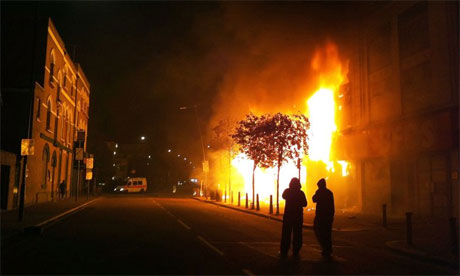
It looked a little like a movie. Cars on fire. Groups of youths in hoodies, their faces covered, running from corner to corner. Shop windows being smashed, and people climbing inside to fetch trainers or TVs or designer cloths. Was it Shank? Kidulthood? Who's starring in this one?
What unfolded on the nation's TV screens between 6 and 10 August wasn't a Sky Movies season of British urban cinema, of course, but the English riots, leaving five people dead and causing an estimated £200m worth of damage to property. And even as they unfolded, there were voices linking the violence to popular culture. On Newsnight, for example, the historian David Starkey huffed and puffed: "What has happened is that the substantial section of the chavs … have become black. The whites have become black. A particular sort of violent, destructive, nihilistic gangster culture has become the fashion." Starkey did not respond to interview requests for this piece, but it's easy to imagine his disgust at seeing one of the recent British films set on an inner-city estate, with black and white characters alike taking and selling drugs, carrying and brandishing guns and knives, talking in identical accents. Maybe he would note the predominance of black characters, and instead of wondering what that said about the British film industry, he would make the assumption that this was everyday black British life.
That is certainly a concern for David Lammy, the Labour MP for Tottenham, whose constituency was where the riots began, and which was especially badly hit. "I think it is a great shame," he says, "something of a travesty that every time we see a portrait of Hackney, Tottenham or Brixton, it is a familiar limited portrait, and it perpetuates a particular imagery and context, when there are many other stories to tell."
Lammy's not the only person to have experienced inner-city life who fears the portrayal of it as a race from one drugs deal to another sends out a particular message. "The effect on our young black people can only be negative when you constantly see your community portrayed, not just in films but on TV programmes, on the news, [with] so much negativity," says Katharine Birbalsingh, who taught in inner city schools for many years. "Young people see that, and yes I do think it helps to glamourise it."
The actor Ashley Walters thinks that is missing the point. "It would be nice for the press and a lot of media people to blame the riots on the urban genre of drama or film," he says. "I guess that's the way to make someone else the scapegoat so that they don't really have to do what they have to do to change it. Things like [the Channel 4 series] Top Boyand Bullet Boy are usually made and produced and put together by people who have a message, and the message they try to get across is that something needs to be done."
That was certainly the intention of Top Boy's writer, Ronan Bennett. "Dramatists over time have tried to grapple with big important issues, and obviously one of the major issues we face right now is the economic and social deprivation that the riots exposed," he says. The questions facing writers, directors and producers now is "how we deal with that in drama, and it can't be by delivering messages, because nobody would watch that show. It has to be cleverer than that: somehow you have got to mix the art of drama with your subject, what you are trying to say about the world. Top Boy really did get people talking. It had an incredible response. I think I probably prefer to think of it as asking questions of the audience and even getting them to ask questions of themselves, how they respond to this culture."
Even when there's an outcry about an urban drama, it at least means it has got people talking about the issues raised. "The majority of people I have spoken to about Top Boy were happy about it," says Walters, one of the show's stars. "But at the same time [some] people despised it and I've had several debates and heated arguments with others who are like, 'Why can't we show black youths in a positive light?' [But] not every ending has to have a moral that suits everyone, and the reality of life is that the majority of time the good guy never wins, it is the bad guy that is on top. There are black kids that do well and don't sell drugs, but that's not what [Top Boy] was about. It was about a drug dealer's lifestyle, and we made it as authentic as possible. It may seem like it is sensational or glamourised – people having their fingers cut off, people being shot in the head, and no value for life – but that is a lot of people's way of life every day."
I'm a 22-year-old from London, and I love urban films. To me, they bring the rich culture and inventive dialogue of inner-city life to the big screen. They are made for young Londoners like me. We can relate to the surroundings, the characters, the themes. We understand that they are there for entertainment: it doesn't mean we are all going to copy what we see on screen. And no one worries about the consequences when entertainment aimed at white audiences portrays violence.
It's certainly a thought that has occurred to Adam Deacon, a nominee for this year's Orange Bafta rising star award, who played Jay in Kidulthood and its sequel Adulthood. "The problem we get with our genre [urban film], is that we always get put in the spotlight," he says. "We could make a hundred Lock Stock and a hundred Snatch movies, but whenever it is a film representing the young generation of today, there is a big problem."
That spotlight creates problems for those who want to make dramas about urban life. When the makers of Top Boy wanted to film in the east London borough of Hackey, they were refused permission. The mayor of Hackney, Jules Pipe, was fearful of the damage a negative portrayal of the area could have on its reputation. That seems likely to become an increasing problem in the wake of the riots: after all, what community leader hoping to regenerate an area is going to want to see the criminality of a small minority portrayed, with the risk that the wider viewing audience won't realise that isn't the everyday life of most people?
Deacon tried to break that vicious circle with his spoof of the urban genre, Anuvahood. "I knew just by talking to young people out there that they didn't want to keep seeing their life on TV or film all the time," he says. "They want to be able to escape from that world and actually be entertained. It is not all negative in these areas, and I think if we were focusing on the positive in the media a bit more then we would have different stories out there. It is just that we are bombarding people with these images all the time."
Are we likely to see a change in the way the inner cities are portrayed, now the dust is settling on the riots? It all depends on what's going to make money at the box office. "I was speaking to Adam [Deacon] the other day," Walters says, "and he was saying it is time we started making things that weren't so negative, and in my mind I was thinking, 'Fair enough, but in order for you to get Anuvahood made, the producer still made you put a gun in there and violence.' You can't get away from it, even though it was a comedy, you're still selling weed in it; you still had to have a violent scene at the end to have anyone interested in watching it in the first place. That's the reality of life.
"If you take a script to producers and financers who invest in TV shows and films, you pitch scripts to them about a boy who did really well in uni and he's black and from an estate in Peckham and he becomes a lawyer, no one is going to take that off your hands."
Deacon, though, holds out hope. "I'm all about trying to put a more positive light on the whole hoodie genre," he says. "I think the 'real street film' was needed. Not only was it made as entertainment, but I think without even realising it, it just opened up a lot of people's eyes – David Cameron was talking about 'hug a hoodie' way back. He's not talking about that now, but it got people talking. I'm not saying it solved anything,but now, for me, I think that there are other ways to tell that story."
Kidulthood Newspaper Response 2
The film that speaks to Britain's youth in words they understand
Fighting, stealing, sex and boozing - your average 24 hours for west London teenagers. It will ruffle feathers, but Kidulthood is a refreshing slice of urban life


Corrine Burton, 18, is on the phone to her friend, Mario. 'You have to see this film!' she trumpets. 'Oh my days ... you would love it! You would so relate to it.'
Corrine and I have just watched Kidulthood, a slick, contemporary, British-made movie set in and around the streets of west London. But there's no Richard Curtis cutesiness in this Notting Hill flick. It's about a group of 15-year-olds given the day off from school due to a suicide in their year. What they get up to in their 24 hours is, frankly, knackering: sex, drugs, booze, fighting, stealing, knifing, gun-toting and an entire Trisha series-worth of arguing.
This is no finger-wagging get-thee-to-a-Jobcentre film, though, but a refreshing, energetic, modern movie that documents urban teenagers' lives with wit and vigour. Slicker and less worthy than last year's acclaimed Bullet Boy, Kidulthood has been described as London's City of God: it's not quite that, but it's a good sight closer to that kinetic portrait of street life than Love Actually. Kidulthood and its talented team of actors showcase what this country is really good at - anti-authoritarianism, music and lust.
The fact that there's a mobile phone or two in there has led some (the Sun) to label Kidulthood the 'happy slapping movie' but, in fact, it examines every current teenage media cliche you'd care to name, from hoodies to unwanted pregnancy.
What's different is that it deals with them all from the teenagers' point of view. Adults are on the periphery: either out of reach, out of touch or, as in the open-minded mother who urges her daughter through her bedroom door to 'use a condom, darling', completely on the wrong track. The daughter's boyfriend is actually about to beat her up.
Kidulthood has had some criticism, from those who accuse it of being unbelievably bleak or, weirdly, voyeuristic (as though we're only allowed to watch films that directly depict our own lives). But for Corrine, from Streatham, south London: 'The film definitely felt real to me. I mean, all that stuff wouldn't have happened in one day, they crammed it in. But the way everyone in that film is, that's how everyone I know is. And the talk is perfect, to be honest.'
The talk is the slang-filled youth vernacular that you hear every day on buses across urban Britain. It's exhilarating to hear it on film in all its filthy, furious glory. And it is filthy: the first thing that one female character says is: 'So I told him, brush your teeth after you lick me out.' That's Becky, played by Jaime Winstone, daughter of Ray. Becky leads the main female character Alisa (Red Madrell) into all sorts of dodgy situations involving blowjobs and full sex for drugs and money. In fact, all of the sex in Kidulthood is part of a barter situation, whether for specific items, respect or love. Often, it takes place in front of other people.
'That's normal! I know girls who are like, any boy will do! It's not about boyfriends,' says Corrine. 'And in front of other people? I do know people like that. Sex isn't really a big issue, it's nothing no more. That is common, you don't think nothing of it.' When I talk to Kidulthood's writer, Noel Clarke (Mickey in Doctor Who), who also plays Sam, the film's bullying bad guy, he agrees with Corrine. 'It seems like sex isn't a big deal these days. There's a weird hippy attitude, like all bodies are the same ... and everyone knows a girl like Becky, just dirty.'
Clarke wrote the screenplay three years ago and based the trio of central male characters - Trife, Jay and Moony, played by Aml Ameen, Adam Deacon and Femi Oyeniran - on himself and his schoolfriends. He says that some of the film's action came from his own life (taxis refusing to stop for him, being falsely accused of shoplifting) and some from friends' experience or the media.
Kidulthood has its fair share of violence; there's a particularly nasty torture scene involving Trife, his bad uncle Curtis and some face-carving. This scene was added to Clarke's original screenplay 'to get a real sense of where Trife could end up,' he explains. 'Either as someone like Curtis or someone on the wrong side of Curtis, the person on the table.'
There's also a horribly aggressive girl-on-girl bullying scene which takes place in front of a whole class of kids who fail to intervene. Corrine was shocked that no character stopped it: 'I would have said something,' she says. 'I wouldn't have jumped in, but I would have said, "Can't you leave her alone?"' This lack of loyalty leads to Corrine's only criticism of the film: how the characters turned on each other. 'That's not friends! That's junior school stuff to me.' She wonders what young people would gain from watching Kidulthood. 'You can see them being influenced for the worse by it or you can see them going, "I don't want to live that life."'
Clarke insists that, though he doesn't want to moralise, he thinks that the film is a cautionary tale: 'It might look cool but you don't want to end up like any of them, not even Alisa [Kidulthood's moral centre]. You shouldn't want to end up like any of them.' And what of older viewers; parents, say? 'Well, how can a parent win?' asks Clarke. 'If you're liberal, you're too liberal; if you're strict, you're too strict. The mother who sanctions her daughter's love life by telling her to use a condom is trying her best. It doesn't matter what's happening on the other side of the door, she's still trying to communicate with her daughter, to reach her. Parents can't win.'
Never mind: even loser parents would be hard-pressed not to enjoy Kidulthood, even as they cringe. This is a rollicking UK youth ride, cinematically filmed, persuasively acted and bumped along by a fantastic all-British soundtrack from the Streets, Audio Bullys, Dizzee Rascal and Roots Manuva. Some youth style publications love it so much that they have offered ad space for free. It's also very funny, laced with a humour of the slapped-in-the-face-with-a-kipper sort: you can't help laughing because it's so outrageous.
It also captures another part of west London, the part the Japanese tourists have missed out on so far. 'Yeah, so far we've only seen one side of the road in films,' says Clarke. 'If you walk out of that nice house and cross that road, there's a council estate bang opposite.'
· Kidulthood is released on Friday
Representation
- recognise that all texts make representations
- deconstruct representations to understand the process by which they are constructed
- question the values, points of view and ideologies of those who made the representation
- evaluate the realism / accuracy / truth of any representation
- explore the reading that the text would like its audience to make, and the different readings that they might make, depending on their values, points of view and ideologies
Thursday, 5 January 2012
The exam topic - Media and Collective Identity
- How do the contemporary media represent nations, regions and ethnic / social / collective groups of people in different ways?
- How does contemporary representation compare to previous time periods?
- What are the social implications of different media representations of groups of people?
- To what extent is human identity increasingly ‘mediated’?
One question to be answered from a choice of six topic areas offered by OCR. There will be two questions from each topic area.
The topic areas require understanding of contemporary media texts, industries, audiences and debates. For the purposes of examination a contemporary media text is defined as being a media text that was published or released within five years of the examination date. For example, in June 2012 a contemporary media text would be any media text from the period of 2007 onwards.
Candidates may analyse the representation of and / or the collective identity of one or more group(s) of people. Candidates might explore combinations of any media representation across two media, or two different representations across two media. Some examples are:
National cinema, television representations, magazines and gender, representations of youth and youth culture, post-9/11 representations of Islam, absence / presence of people with disability in two media.